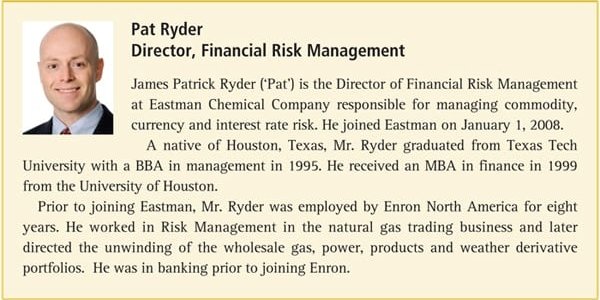
by Pat Ryder, Director, Financial Risk Management, Eastman Chemical Company
Founded in 1920, Eastman Chemical Company is a global chemical company that manufactures and markets a broad portfolio of chemicals, fibres and plastics. Eastman has 20 manufacturing locations globally, and employs approximately 10,000 professionals. In 2011, the company generated sales revenues of $7.2bn.
Project background
In the past, risk management was undertaken on a siloed basis at Eastman. FX risk was managed by the pensions manager, and commodity risk was the responsibility of procurement, with a variety of disparate systems in place. At Eastman, we pride ourselves in engaging the best people, processes and technology, and in maintaining a best-in-class position across all of our activities. We recognized that we needed to refine our approach to risk management to align with these standards, so we approached our Board with a view to transforming the way that we assess and manage risk. We have a high-calibre Board, whose members have a detailed understanding of risk management issues. We therefore received considerable support for this initiative amongst senior management, which is imperative for delivering a complex project with a variety of stakeholders.
Centralizing risk
We recognized that we would be in a better position to monitor and manage risks on a group-wide basis if risk management was centralized in treasury. This would allow us to establish correlations between different types of risk, rationalize systems, and make our hedging more efficient. Having centralized risk-related activities, we needed to understand the reasons behind the risk management approach we had adopted in the past. This involved working with stakeholders across the business to understand where exposures are created, and how information is used. We recognized that data and process integrity was essential at every stage in order to ensure the quality and timeliness of risk management decision-making. We also needed to take into account the needs of each stakeholder and to make sure they understood and embraced a new approach.
An EAR strategy
Following this process, we focused on our commodities risk, which is one of the most significant risks for Eastman. We had previously monitored commodities risk on a short-term basis, and hedged a small proportion, primarily determined by the cost of hedging. We decided to modify this approach to adopt an earnings at risk (EAR) model. EAR measures the amount by which net income might change in the event of an adverse change in risk, created by changes to interest rates, FX rates or commodity prices. It is similar to value at risk (VAR); however, while VAR looks at the change in the entire value over the forecast horizon, EAR focuses on potential changes in cash flows or earnings. To achieve this, we sought to introduce a variety of advanced modelling techniques. We also needed the ability to perform iterative calculations over multiple time periods, taking into account every hypothetical change to prices. By modelling different scenarios across the risk-return spectrum, we could then make hedging decisions on a portfolio basis with a view to reducing earnings volatility. We are also taking the same approach to currency risk, although with different calculations due to the different way in which currencies are priced.
Sign up for free to read the full article
Register Login with LinkedInAlready have an account?
Login
Download our Free Treasury App for mobile and tablet to read articles – no log in required.
Download Version Download Version