myTMI logo

Please login to access your profile


Financial Supply Chain

Page 1 of 2

Supply Chain Financing Comes of Age

by Lex Greensill, Managing Director, Head of Supply Chain Finance for Europe, Middle East & Africa, Citi

Multinational firms have developed highly complex, sophisticated supply chains in recent years, but the recent tragic events in Japan have illustrated that while many factors can be controlled, every supply chain remains inherently fragile. While treasurers and finance managers cannot protect their supplier base physically, they are in a position to support them financially and therefore ensure that the financial elements of the supply chain are as efficient as possible. In doing so, they both preserve the company’s working capital position and are in a position to leverage the company’s financial assets as a source of financing.

Financing in good times and bad

Supply chain finance (SCF) has developed significantly since the credit crisis. Previously seen as a source of financing for small and medium-sized enterprises or companies in distress, an increasing number of firms, particularly large multinationals with strong credit ratings, have recognised the potential of SCF to help unlock liquidity and increase the robustness of the financial supply chain. In many cases, SCF was considered a stop-gap financing technique during a period of market turbulence, but it has rapidly become apparent that it is not simply a technique for troubled times. As markets start to ease globally, the value of SCF remains undiminished, and could be even greater in the coming years. With more conservative credit models and more stringent banking regulations, credit will not be as cheap or accessible as in pre-crisis days, while optimising liquidity will remain key to funding future investments.

Creating a ‘win win’

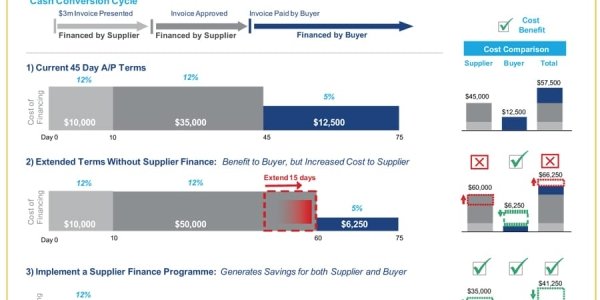
There are few financial structures which can truly be said to create a ‘win win’ for both parties, but SCF is undoubtedly advantageous for both buyers and sellers (figure 1). For example, buyers find that:

  • Their financial supply chain becomes more resilient as key suppliers have greater financial certainty and are therefore in a better position to fulfil orders on time, reducing risk in the buyer’s financial supply chain.
  • The cost of processing is reduced as the numbers of supplier queries, in-house payments processing and payment fees are reduced.
  • Relationships with suppliers are improved, with the potential for achieving better commercial terms without negatively impacting on suppliers.
  • An SCF programme does not compromise a company’s ability to source other forms of financing, and does not impact on its credit rating.


For the supplier, the benefits are comparable:

  • Cash flow is predictable, as invoices are settled on time by the buyer’s bank. Working capital requirements are therefore reduced and cash flow becomes less constrained. Suppliers may also be able to offer more competitive terms as the cost of late payment does not need to be factored into invoices.
  • There is the option to seek early payment as a means of financing. This financing is effectively pre-approved and is not subject to the supplier’s financial standing. For companies that could not otherwise source financing, or where the cost would be prohibitive, this can be a major benefit. For those with alternative means of financing, credit lines are released for other purposes.
  • Reconciliation, account posting and management reporting is enhanced as remittance information is provided in a format that can be integrated with internal systems.

Initial objectives, secondary benefits

What has gradually become apparent as the number of SCF programmes increases is that companies have quite different business objectives when they first establish a programme, but that they subsequently experience additional advantages. For example, at a recent roundtable event hosted by Citi, a variety of companies discussed their experiences of SCF, including the initial motivation for establishing a programme. For example, for Philips, the key objective was working capital improvement; however, Bart Ras, Philips emphasises that the programme also enhanced the company’s competitive position,

“For example, just before the football World Cup, there was a shortage in the panel market, since many of the factories producing panels had closed down… They prioritised Philips as they could receive payment very quickly, as opposed to perhaps 60-day terms from another customer. Consequently, introducing a supply chain financing programme has proved to be a fantastic product to help sales and marketing and to satisfy demands from our customers.”

A markets start to ease globally, the value of SCF remains undiminished, and could be even greater in the coming years.

For Rolls Royce, the aim was to protect suppliers’ financial position, and therefore increase the resilience of the supply chain, but the working capital advantages have since become more apparent,

“A key issue that we face is security of supply: how do we ensure that our supply chains will remain resilient in the long term? This issue was particularly significant during the crisis, with the risk that suppliers would go out of business due to lack of liquidity, which would in turn have a very considerable impact on our business.

As the economy recovers, and liquidity constraints become less acute, an unexpected benefit has been the opportunity … for Rolls Royce to access working capital quickly and cheaply to fund the growth that we are planning… So we have been able to mitigate risk, optimise working capital and work more closely with suppliers, and in turn, to start building the supply chains of the future.” 

Participants in SCF programmes

As SCF became more prevalent, many believed that only suppliers with a credit rating lower than the programme owner would be most attracted to SCF. In fact, companies have found that suppliers with an equal or higher rating have joined the programme, for a variety of reasons. Andrew Leach, Rolls Royce explains,

“Although we set up the programme to manage our risk to smaller or more vulnerable companies, we are actually seeing more blue chip and bigger companies using the programme than the smaller ones it was originally intended for. But these firms want  to manage their balance sheet, by leveraging off-balance sheet financing options, and optimising their working capital. It’s also a zero cost option for them: they only pay for it when they use it.”

For a higher rated company, the cost of discounting the receivable through an SCF programme may be a little higher than obtaining credit through a bank line or equivalent mechanism; however, as Bart Ras, Phillips outlines, this is not necessarily a disincentive,

“As Citi makes a non-recourse payment to the supplier, it has the effect of shortening the balance sheet, and is an alternative form of financing working capital without utilising a bank line. So many CFOs are happy to slightly overpay for discounting the receivable, in order to avoid bank debt and remove accounts receivables from the balance sheet. This is something we now do ourselves as well by joining our customers’ supply chain finance programmes.”

Next Page 1 2 

If you wish to read the rest of this article, please login to your myTMI account
or simply register now for free.

You will then also be able to read online, download and print the article.

It only takes 30 seconds and you will also benefit from the following:

- Our Monthly eNewsletter
- Regular Treasury Updates
- Unlimited Article Downloads
- Access to all premium articles
- Access to MyTMI Area

Register today for free!

pdf icon  Download this article for free

Print Ready icon  Print Ready version of this article

Discover the benefits of myTMI

Save PDFs of your favorite articles, authors and companies. Bookmark this article, or add to a list of your favorites within mytmi.

Register Today for FREE!

Other Articles icon  Show articles by this author

email to firend  Share this articleShare article on LinkedIn  Share article on LinkedIn
Share article on Twitter  Share article on Facebook Share article on Twitter  Share article on Twitter

Lex Greensill Article by
Lex Greensill
Managing Director, Head of Supply Chain Finance for Europe, Middle East & Africa, Citi

add author to add to my tmi

back to Financial Supply Chain category

People who read this also looked at these articles ...

The PwC European Working Capital Study

Damien McMahon, Didier Vandenhaute and Martin Böhme, PwC, Finance and Treasury Solutions

A Pan-Regional Approach to Liquidity and Bank Connectivity

Benoît Mulsant, Treasury Manager, PSA Peugeot Citroën

Implementing Technology to Achieve Group Strategy

Luc Vlaminck, Group Treasurer, Rémy Cointreau

Thinking the Unthinkable: A new chapter in FX risk management?

Helen Sanders, Editor

Treasury Centre Stage

Matthew Davies, Global Treasury Solutions, EMEA Corporate Sales Head, Bank of America Merrill Lynch, and John Harris, Global Treasury Solutions, Senior Treasury Management Sales Officer, Bank of America Merrill Lynch

The Changing Landscape of Treasury Risk Management

TMI is published in association with:

EACT logo IGTA logo

Click here for international partners

  • ACTS logo
  • ACTSA logo
  • ACTSR logo
  • AFTE logo
  • AITI logo
  • ASSET logo
  • ATEB logo
  • ATEL logo
  • CAT logo
  • DACT logo
  • IACCT logo
  • IACT logo
  • JACFO logo
  • KCFO logo
  • SAF logo
  • LTA logo
  • SCTA logo
  • TMANY logo